
I don't often come across living artists with whom I think I have a significant amount in common. My interest in German artist Tim Eitel began with a photograph of the artist standing next to one of his paintings, installed in a gallery. The painting was about 8x10 inches, on a chunky stretcher, meticulously painted, and pictorial in nature-- at first glance it could have been one of my own paintings.
Eitel's paintings typically depict figures in landscapes or generic public architectural spaces, and mundane contemporary stuff like dumpsters and trash, pigeons, trailers, beds (sometimes on their own, and sometimes as props in figurative paintings). He paints in oil on canvas, blending the paint to create smooth, atmospheric paintings, which are sometimes very large scale, sometimes very small. The images are quite realistic, but often with some flatly painted blank areas. Looking at a screen of google image result thumbnails, the palette is noticeably subdued-- grays dominate.
The artist says that he is "mainly trying to turn [his] attention to life in our time." He believes our world view is made up of a "reservoir of images" (from art history, photography, film, TV, newspapers), which for him can be condensed into archetypal images that he then seeks out in the world and paints. I can't quite see from his work what these archetypal images, or their significance, might be, but I do respond to his choice of images-- they seem true to my experience of the world. Even more, I respond to the series of photos taken by the artist as a sort of sketchbook-- I use photography (and found photos from media) similarly in my own work, and am also drawn to bland and common images from our world, especially depicting the artificial and man-made in nature. The artist acknowledges that he is interested in the unnatural in nature-- how even when he's out in nature, he feels like he's in some sort of controlled recreation zone. His paintings seem critical of that artificiality-- particularly the ones with figures, who seem alienated from their surroundings. In my own work, I don't feel negatively about the artificiality of the environment, but instead see it as full of evidence of our unique human brain that wants to transform, adapt, problem solve, discover through science, etc.
The space in Eitel's paintings is interesting, and something I could see stealing-- he often avoids having a horizon or distant space through foggy environments, or using wall-like spaces (black or gray) to simply end the foreground.
On the whole, I don't care for his figurative paintings. The figures seem very still and unnatural (appropriately to his concept)-- for me they are unpleasant and creepy.


Forrest Bess
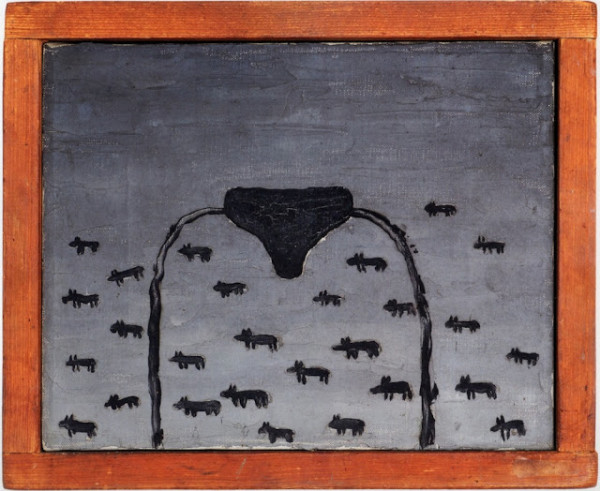
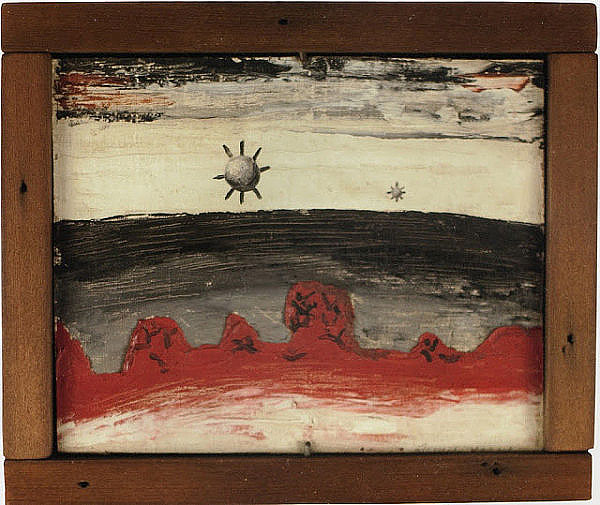
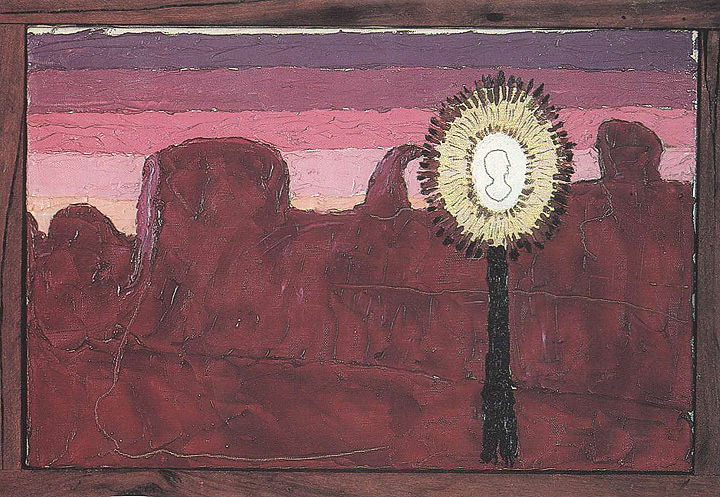
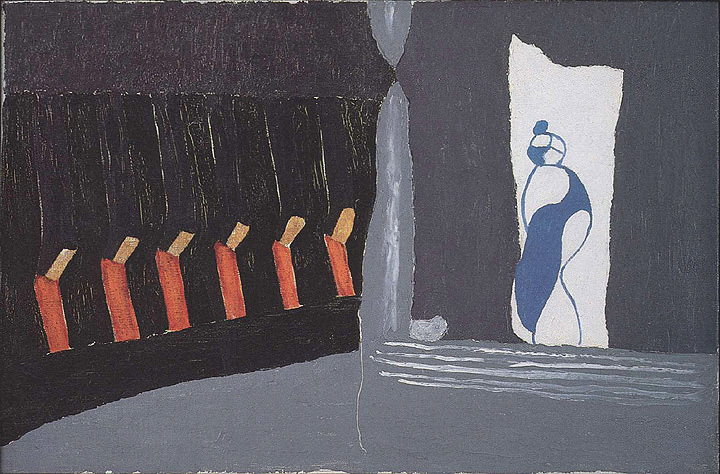
I guess my main question about this artist is why do I (and presumably others) like these paintings so much? I think it is a combination of Bess' focus and commitment to the importance and value of each image, and the true individuality of his work. Looking at his work, the word that comes to my mind again and again is emblem-- so many of his paintings seem like emblems of something. This is probably in part due to the frequent centering of the image in the composition. There is something other-worldly about them too, in almost an alien sense (especially the landscapes), like Bess is witness to another world. Bess is known as a visionary artist, and it's easy to see these as images of visions. The unrefined painting style and handyman frames seem to give even more emphasis to the power of the image itself.
Something I love in art in general is when an artist's work perfectly represents his/her vision of the word-- this happens so well with Bess.
A thought: a centered image makes it clear that it's the image that's important, rather than the painting of the image.
Bess lived (1911-1977) in Texas, worked as a fisherman, and painted in his spare time. He was discovered by a New York dealer, and exhibited his work there and in other places. He had many eccentric theories about the world, based on Jung, alchemy and Australian aboriginal rituals, including that becoming a hermaphrodite was the key to immortality! It is not clear whether he performed surgery on himself, or a doctor did it, but he eventually became a "pseudo-hermaphrodite." (Wikipedia)
Something I love in art in general is when an artist's work perfectly represents his/her vision of the word-- this happens so well with Bess.
A thought: a centered image makes it clear that it's the image that's important, rather than the painting of the image.
Bess lived (1911-1977) in Texas, worked as a fisherman, and painted in his spare time. He was discovered by a New York dealer, and exhibited his work there and in other places. He had many eccentric theories about the world, based on Jung, alchemy and Australian aboriginal rituals, including that becoming a hermaphrodite was the key to immortality! It is not clear whether he performed surgery on himself, or a doctor did it, but he eventually became a "pseudo-hermaphrodite." (Wikipedia)

Catherine Murphy
I've been interested in Catherine Murphy for a while, mostly because she is a painter who uses a realistic style, but doesn't seem to care about Realism, and she manages to have a career in contemporary art (not in a realist ghetto). There is an interview with her in Hyperalleric with some really interesting stuff. http://hyperallergic.com/141273/beer-with-a-painter-catherine-murphy/?utm_medium=email&utm_campaign=Weekend+OK+Great+Arthur+Sze+Catherine+Murp
Here are some quotes:
_One of the big breakthroughs for me was when I decided I could paint my dreams. It was like someone had let me out of prison. It meant that I set up situations where I controlled the light. That’s been tremendous.
_My whole approach to painting used to be a moment of recognition. It used to be something I saw that moved me, and I would work from there. But now, I want to make that happen for other people. Initially, it doesn’t always have to happen for me. So, it comes from memory, or my id, and it often comes from recurring dreams and things I’m possessed by.
_Poetry has taught me a lot. I’m thinking of Elizabeth Bishop. How do you frame it, either in language or in painting, so that people see it? How do you take something ordinary, that people see every day, and frame it so that you change the equation? That same thing happens in a poem.

There is also an interesting explanation of the red lipstick painting:
I also learned from the interview that Murphy is friends with Robert Mangold, Thomas Nozkowski, and likely other famous artists-- this may be how she has a career!
So, how does her work avoid looking like traditional, run of the mill realism? I think a big part is that everything has a kind of graphic clarity and spareness. She avoids complicated light/shadow situations (she blacks out her studio windows in order to control the light). And some of the contemporary, non-traditional feeling comes from her choice of subject matter (there's nothing that would qualify as landscape, portrait, still life). Then there's the way she only paints a thing once-- there is no body of work of lips, for instance. Each work is a unique image.
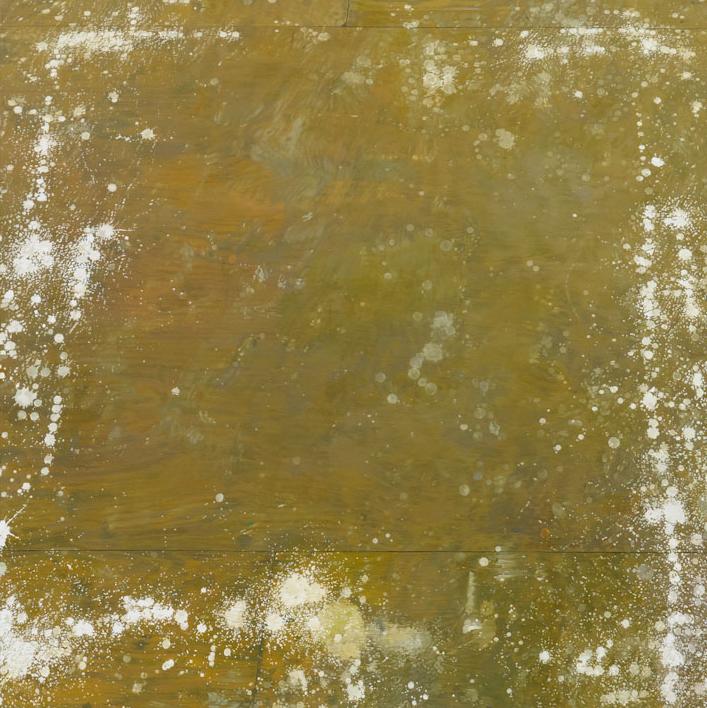
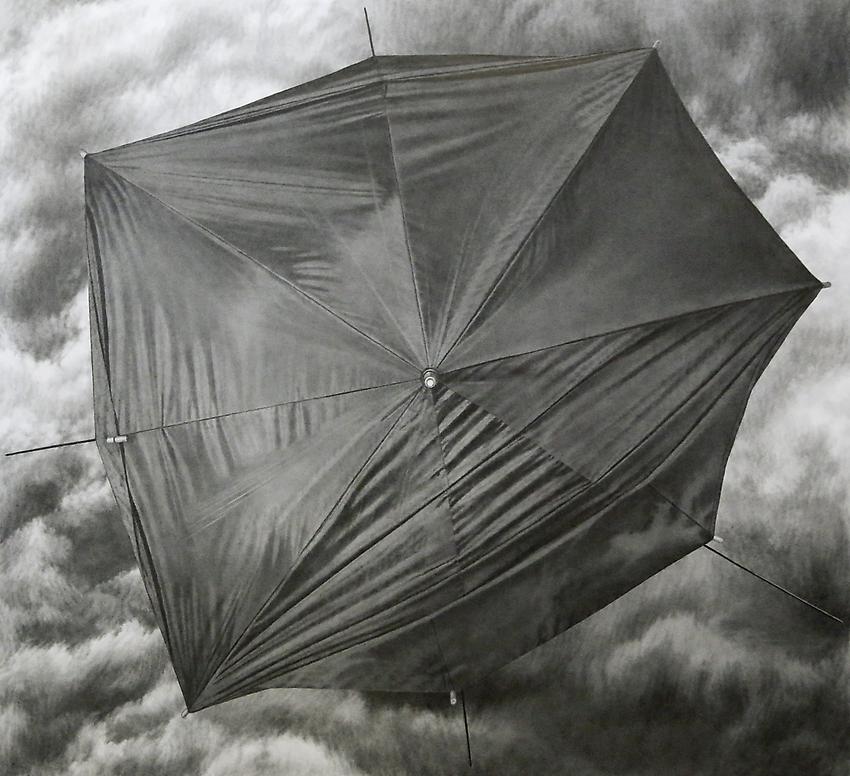
The most interesting thing for me at this moment in my own work is the notion of making a painting that is poetic-- in Murphy's words taking an ordinary, everyday thing and framing it so that people see it, or the equation is somehow changed. Looking at Murphy's paintings I recall that I have recently felt emotion at seeing something similar (two garbage bags, a snow-less spot in the snow) out in the world. I also see some similarity in our work in the depiction of curtains, windows, and empty surfaces. Murphy mentions being attracted to flat surfaces as subject matter (things that look spatial but are not spatial). For myself I think these surfaces represent some kind of interior, meditative (brain) space, and are attractive as such. A tabula rasa. I notice also Murphy's painting looking into a red chair or box, or the one of hoses and a snake-- the space there is very much about the human head doing the looking. It's so rare to find a kindred spirit in the art world. Looking at her work I feel braver about the possibility of using realism, and I feel challenged to make better paintings!


other articles:
http://hyperallergic.com/67886/catherine-murphys-challenge/
http://hyperallergic.com/78444/the-inimitable-and-influential-art-of-catherine-murphy/
Here are some quotes:
_One of the big breakthroughs for me was when I decided I could paint my dreams. It was like someone had let me out of prison. It meant that I set up situations where I controlled the light. That’s been tremendous.
_My whole approach to painting used to be a moment of recognition. It used to be something I saw that moved me, and I would work from there. But now, I want to make that happen for other people. Initially, it doesn’t always have to happen for me. So, it comes from memory, or my id, and it often comes from recurring dreams and things I’m possessed by.
_Poetry has taught me a lot. I’m thinking of Elizabeth Bishop. How do you frame it, either in language or in painting, so that people see it? How do you take something ordinary, that people see every day, and frame it so that you change the equation? That same thing happens in a poem.
_No one believes this, but I’m not interested in technique at all; I’m not even interested in making detail. I’m interested in clarity. I want to get it to the place where all of a sudden, like when you’re doing the test at the eye doctor’s and they revolve the machine, and it’s like, “Oh yeah, those are the glasses I need.” I want it to be really in focus. I want to be responsible for every square inch of the painting.
_I think about how you never find a morel twice in the same place in the woods. I find that somehow, nature does not want to be seen. So, in painting, how do you stop being trapped? I love the history of painting, but you can’t get trapped there and just repeat. Do you want to be a representational painter so that you continue the tradition of a certain kind of seeing and framing because it’s comforting? Or do you want people to look at a painting so that they see again?
There is also an interesting explanation of the red lipstick painting:
The lipstick painting started by looking in my compact, and understanding that lipstick has a spatial effect. It puts your lips on another plane than your face. I thought, I’m going to do a painting about that.
In the middle of it, there was a voice in my head that said, “Smear it.” So I smeared it, and I almost couldn’t breathe. I saw my childhood flash in front of me. There were a lot of out of control people in my life when I was a kid. I had women come up to me, very close, with smeared lipstick all over their faces because they were drunk, or not in control. Smearing the lipstick was doing it to myself: that thing I didn’t want to happen to me.
I also think about what is not needed in the painting. If there were eyes in the painting, if there was anything else but those lips, the power would all go away. It would have not talked to this thing that I wanted to talk to. That is how I make many decisions about the paintings: how I’m going to frame the thing so that you see what you didn’t see before.I also learned from the interview that Murphy is friends with Robert Mangold, Thomas Nozkowski, and likely other famous artists-- this may be how she has a career!
So, how does her work avoid looking like traditional, run of the mill realism? I think a big part is that everything has a kind of graphic clarity and spareness. She avoids complicated light/shadow situations (she blacks out her studio windows in order to control the light). And some of the contemporary, non-traditional feeling comes from her choice of subject matter (there's nothing that would qualify as landscape, portrait, still life). Then there's the way she only paints a thing once-- there is no body of work of lips, for instance. Each work is a unique image.
The most interesting thing for me at this moment in my own work is the notion of making a painting that is poetic-- in Murphy's words taking an ordinary, everyday thing and framing it so that people see it, or the equation is somehow changed. Looking at Murphy's paintings I recall that I have recently felt emotion at seeing something similar (two garbage bags, a snow-less spot in the snow) out in the world. I also see some similarity in our work in the depiction of curtains, windows, and empty surfaces. Murphy mentions being attracted to flat surfaces as subject matter (things that look spatial but are not spatial). For myself I think these surfaces represent some kind of interior, meditative (brain) space, and are attractive as such. A tabula rasa. I notice also Murphy's painting looking into a red chair or box, or the one of hoses and a snake-- the space there is very much about the human head doing the looking. It's so rare to find a kindred spirit in the art world. Looking at her work I feel braver about the possibility of using realism, and I feel challenged to make better paintings!
other articles:
http://hyperallergic.com/67886/catherine-murphys-challenge/
http://hyperallergic.com/78444/the-inimitable-and-influential-art-of-catherine-murphy/

No comments:
Post a Comment